
Get In Touch
- Phone + 123 5647 8900
- Email Meetpatel@gmail.com
- Address Based on Houston city, USA
- Follow us

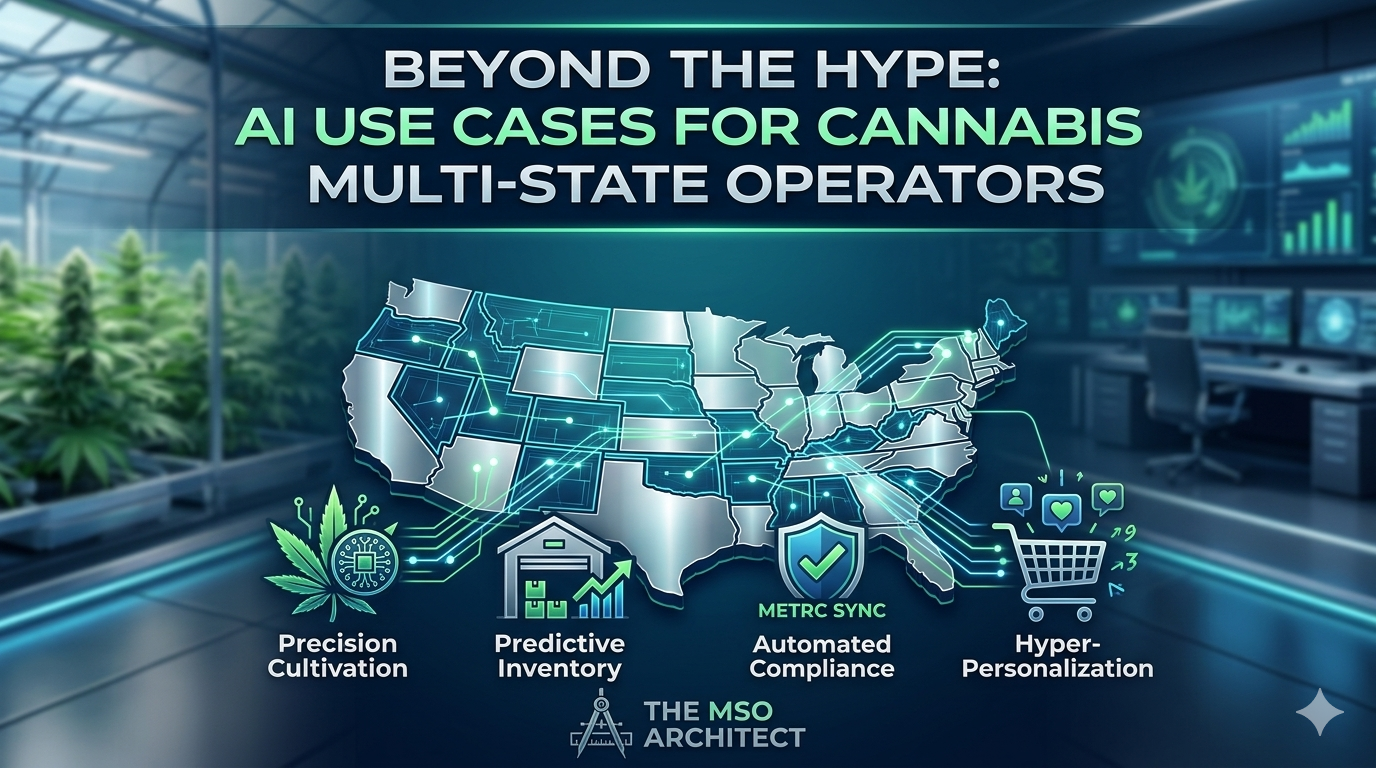
Beyond the Hype: AI Use Cases for Cannabis Multi-State Operators
In the cannabis industry, we have a bit of a “shiny object” problem. Every few years, a new buzzword promises to revolutionize the way we grow, sell, and track this plant. First it was blockchain for traceability, then it was NFT-based loyalty programs, and now, it’s Artificial Intelligence.
But if you are running a Multi-State Operation (MSO), you don’t need hype. You need things that actually work at scale across different regulatory climates, different time zones, and different tax codes. You need systems that protect your license while expanding your margins. As someone who looks at the industry through the lens of technology architecture, I have seen where AI is just an expensive toy and where it is a legitimate operational engine. In 2026, we are finally moving past the experimental era of AI. We are seeing it get “under the hood” of the most successful MSOs.
This isn’t about robots trimming flowers or “AI budtenders” that give generic advice. It is about using machine learning to solve the boring, expensive, and high-risk problems that keep us up at night.
The 2026 Reality: From “What if” to “How to”
A few years ago, we talked about AI in the future tense. Today, it is part of the digital foundation. With the shifting federal landscape and the eventual relief from 280E, the goal for any MSO isn’t just to grow more; it’s to operate more intelligently.
The biggest drain on a multi-state business isn’t usually the cultivation, it is the cost of complexity. When you operate in five states, you are not running one company. You are effectively managing five different regulatory environments, five supply chains, and five operational playbooks.
Practical AI is the “connective tissue” that brings these pieces together. Here is how it is actually playing out in the real world right now.
1. Predictive Inventory & “Self-Healing” Supply Chains
The hardest part of being an MSO is getting the right product to the right store before it loses its value. Cannabis is a perishable agricultural product. Every day a batch of flowers sits in a warehouse in Illinois while demand is spiking in New Jersey, you are losing money.
A few years ago, while advising a mid-sized MSO on their operational workflow, the leadership team shared a cautionary tale regarding a shipment that sat in a warehouse for ten extra days. The delay was caused by a late demand signal from their retail stores; by the time the product finally reached the shelves, the terpene profile had noticeably degraded. To move the inventory at all, they were forced to apply heavy discounts, effectively wiping out the entire margin for that batch.
Traditional inventory management is reactive. You look at a report from last week and try to guess what you’ll need next week. AI-driven Demand Forecasting flips this.
How it works in practice:
By feeding historical sales data, weather patterns, local events, holiday schedules, and even social media sentiment into machine learning models, operators can forecast demand with remarkable precision weeks in advance.
| Traditional Management | AI-Enabled Management |
| Reactive: Ordering based on last month’s “gut feeling.” | Proactive: Ordering based on predictive trend modeling. |
| Siloed: Each state manages its own stock in a vacuum. | Unified: AI treats inventory as a fluid, regional resource. |
| Wasteful: High percentage of “dead stock” or expired products. | Lean: Stock levels stay low while maintaining 100% availability. |
In 2026, we are seeing the rise of “self-healing” supply chains. If a storm is forecasted for the Northeast that might delay a shipment, the AI doesn’t just send an alert; it automatically adjusts the fulfillment orders from a different hub to ensure the retail shelves stay full.
2. The “Automated Compliance” Layer
If there is one thing that keeps every MSO leader awake, it’s an audit. One bad sync with METRC, one missing plant tag, or one clerical error in a transfer manifest can cost you a license that is worth tens of millions of dollars. For a long time, compliance was a manual, human-heavy process. You had teams of people double-checking tags against spreadsheets. AI has changed that from a “check-box” task to a continuous monitoring system.
I once sat in on a compliance review where the team spent half a day reconciling a single inventory discrepancy between their POS system and the state track and trace database. Nothing illegal had happened. A simple data sync error created hours of manual verification because nobody wanted to risk triggering an audit flag.
The “Triple-Check” Method
Modern AI systems now act as a 24/7 auditor. They aren’t just recording data but they are looking for anomalies.
- Real-time Reconciliation: The AI compares your physical inventory (via cameras or sensors) against your POS data and your state-mandated track-and-trace system (like METRC).
- Anomaly Detection: If the system sees that 50 units were “lost to waste” in a facility that usually averages 5 units, it flags it for immediate review before it becomes a regulatory red flag.
- Regulatory Scanning: AI models now scan thousands of pages of new state regulations to summarize exactly how a rule change in Massachusetts affects your specific SOPs.
This moves compliance from a “cost center” to a “safety net.” You aren’t just staying legal; you are building a data-rich history that makes your company much more attractive to institutional investors.
3. Precision Cultivation & Stress Detection
We have moved past the days of “master growers” keeping their secrets in a notebook. Today, cultivation is a data game. MSOs are dealing with massive canopy spaces across different climates. Maintaining consistency, the “McDonald’s effect” of cannabis, is incredibly hard.
AI-enabled cultivation platforms use a mix of sensor data and computer vision to manage the “living” part of the business.
Beyond Automation
It’s easy to automate a light timer. It’s hard to predict a powdery mildew outbreak three days before the human eye can see it.
One cultivation director I spoke with described losing nearly an entire room to powdery mildew before the issue was visible to the human eye. By the time the first white spots appeared on the leaves, the infection had already spread across hundreds of plants. Today, computer vision models can detect those stress signals days earlier.
- Early Stress Detection: Using high-resolution cameras, AI can spot minute changes in leaf pigment or “turgor pressure” (how the plant holds water) that indicate stress or nutrient deficiencies.
- Yield Forecasting: By analyzing the growth rate of a specific phenotype under specific light/CO2 recipes, AI can give a highly accurate harvest weight forecast weeks in advance. This allows the sales team to start pre-selling the crop with confidence.
- Environmental Optimization: Instead of running the HVAC at a set level, AI adjusts it in real-time based on the plants’ transpiration rates, significantly cutting energy costs.
4. Hyper-Personalization: The End of the “One-Size-Fits-All” Menu
On the retail side, MSOs often struggle with “Menu Fatigue.” A customer walks in, sees 400 different SKUs, and ends up buying whatever the budtender suggests or whatever is on sale. This isn’t a great way to build brand loyalty. AI is finally making Hyper-Personalization possible without being creepy.
The Agentic Concierge
In 2026, we are seeing “Agent-Driven” commerce. This isn’t a chatbot that says “How can I help you?” It is an AI that has access to a customer’s past purchase history, their preferred effects (e.g., “sleep” or “anxiety relief”), and real-time store inventory.
- Intent-Based Recommendations: If a customer always buys high-CBD gummies on Thursday nights, the AI can send a personalized offer for a new 1:1 tincture that just hit the shelf at their local dispensary.
- The “Invisible” Budtender: AI can analyze which products are frequently bought together and automatically update the digital menus to show “Recommended Pairs,” similar to how Amazon or Netflix works.
- Dynamic Pricing: MSOs are starting to use AI to adjust prices in real-time. If a specific strain is selling fast in one zip code but sitting on the shelf in another, the AI can offer a “happy hour” discount to the slower location to move the stock before it gets old.
5. From Spreadsheet Mess to the “Cannabis OS”
Perhaps the most practical use of AI for an MSO is simply Data Consolidation. Most operators are drowning in data but starving for insights. You have a POS system, a separate HR platform, a cultivation suite, and an accounting package. They don’t talk to each other.
I’ve always believed that the winner in the MSO space will be the one with the best Operating System (OS). AI is the engine of that OS. It can ingest millions of rows of messy data from ten different states and spit out a single dashboard that tells a CEO exactly where the business is leaking money.
Why this matters for the bottom line:
- Labor Optimization: AI can look at your foot traffic patterns across all 50 stores and tell you exactly how many budtenders you need on a Tuesday at 2:00 PM vs. a Friday at 4:00 PM.
- CAPEX Decisions: By analyzing the performance of different facilities, AI can help you decide where to invest your next $5M, whether it’s an extraction lab in Nevada or a greenhouse expansion in Arizona.
Conclusion: Start Small, Think Architectural
If you are an MSO executive, the path forward isn’t chasing “General AI” hype. You don’t need an LLM that can write verses, you need an Industry-Specific Operating System that can reconcile your METRC tags and pinpoint the 10% of SKUs driving 80% of your profit. The goal isn’t to replace your people. It is to give your master growers, compliance officers, and store managers the “superpowers” required to manage a business that has outpaced its tools.
In the cannabis industry, the “architects” who build on a foundation of data will be the ones left standing when the dust of federal legalization finally settles. Don’t wait for the tools to catch up to your ambition, build the blueprint now.
To see the architectural blueprints for a data-driven MSO, book a strategy session here!