
Get In Touch
- Phone + 123 5647 8900
- Email Meetpatel@gmail.com
- Address Based on Houston city, USA
- Follow us

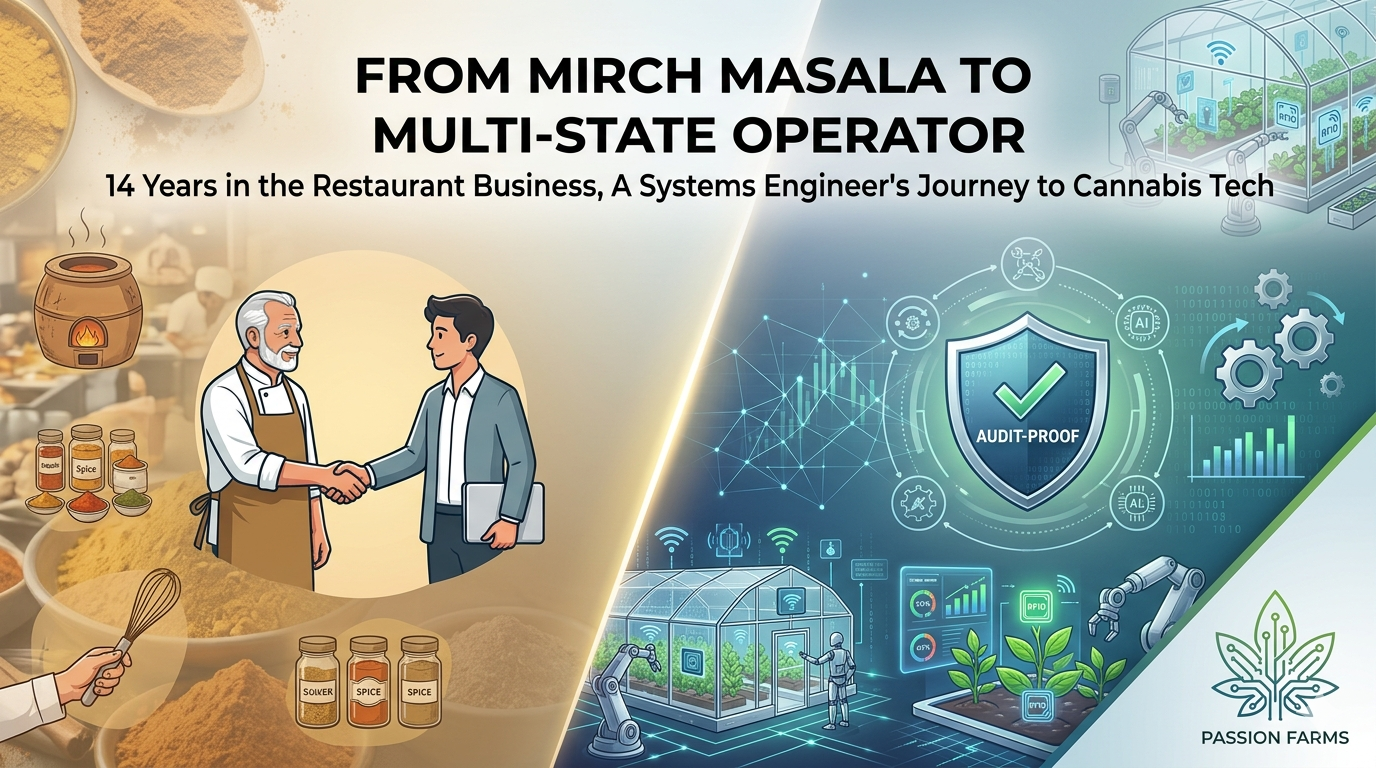
From Mirch Masala to Multi-State Operator: What 14 Years in the Restaurant Business Taught Me About Cannabis Tech
If you look at my resume, you might see two different worlds. On one side, there is Madhuram Mirch Masala, my family’s restaurant and spice business in Houston, a place defined by the heat of the kitchen and the precision of spice blending. On the other hand, there is Passion Farms, where I am architecting proprietary technology systems for the cannabis industry. To an outsider, these look like unrelated paths, but to a systems engineer, they are exactly the same problem.
In 2026, the cannabis industry is finally moving past its “wild west” phase and entering its “efficiency” phase. This is a shift I recognize because it’s the same evolution the restaurant industry underwent decades ago. When your margins are thin and your inventory is perishable, you don’t win by having the “coolest” brand, you win by having the tightest operations.
Here are the three fundamental “restaurant” truths that I’ve baked into the proprietary cannabis operating systems we build today.
The Kitchen-to-Cannabis Playbook: Operations Lessons That Scale
Running a restaurant teaches you one brutal truth: margins are protected through systems, not hustle. Cannabis operations follow the same logic. When inventory is perishable and compliance is strict, success comes from disciplined processes and real time data. The restaurant floor and the cannabis facility may look different, but the operational principles are identical.
1. The “Perishable Data” Rule: If You Can’t Track It in Real-Time, It’s Already Rotting
In the restaurant business, “shrink” isn’t just a line item; it’s a daily battle against time. If a crate of tomatoes sits in the walk-in for three days too long, your margin on that week’s specials evaporates. Cannabis is exactly the same, only the “tomatoes” cost $1,500 a pound and require a state-mandated digital paper trail.
- Restaurant Lesson: Inventory management is a high-speed game of “Hot Potato.”
- Cannabis Tech Application: We built our demand engines to treat flowers as a “live” asset with a shelf-life clock, rather than static inventory.
- The Result: We use predictive analytics to ensure that product moves from the vault to the retail shelf while the terpene profile is at its peak, maximizing both price and patient experience.
2. Recipe Standardization: The SOP is Your Only Shield Against Chaos
In a kitchen, “consistency” is the difference between a loyal customer and a bad Yelp review. You achieve that by having a Standard Operating Procedure (SOP) for every single pinch of salt. In a $10M cannabis operation, you need that same level of “Recipe” discipline, but instead of salt, you are managing nutrient ratios, humidity setpoints, and METRC tag reconciliations.
- Restaurant Lesson: If it’s not in the manual, it doesn’t happen on the floor.
- Cannabis Tech Application: I’ve replaced “dusty binders” with digital, mobile-first workflow managers that track task completion in real-time.
- The Result: Whether a technician is in a grow room in California or a processing lab in New Jersey, the “recipe” for compliance and quality remains identical.
3. The “Hospitality” of Data: Why the Tech Should Feel Invisible
The best service in a restaurant is the kind you don’t notice, your water glass is filled before you’re thirsty, and the check arrives right when you’re ready to leave. I believe cannabis tech should be the same. Budtenders and growers shouldn’t have to fight with clunky software or spend hours on data entry; the system should serve them.
- Restaurant Lesson: Technology should enhance the “guest” experience, not distract from it.
- Cannabis Tech Application: We integrate our POS and CRM so that the “data” does the heavy lifting, allowing the budtender to focus on the person standing in front of them.
- The Result: Higher retention, better staff morale, and a brand that feels human despite being powered by a complex MIS architecture.
The Indian-American Entrepreneurial Spirit in Cannabis
For many Indian-American families, entrepreneurship isn’t just a career choice; it’s a survival mechanism forged in the high-stakes environments of hospitality and retail. This “restaurant grit”, the ability to manage razor-thin margins and 80-hour workweeks, is exactly what fuels our transition into the cannabis space. We aren’t just entering a new market but we are applying a multi-generational blueprint of resilience to a frontier industry.
However, that spirit is now being tested by the “elephant in the room” for any $10M operator: The Compliance Pivot. In the traditional family business, an unannounced health inspection was a stressful afternoon, but it rarely threatened the foundation of the legacy. In cannabis, the stakes have evolved. An audit is no longer a checklist, it is a forensic examination of every gram, every METRC tag, and every digital footprint.
The Shift from “Grit” to “Governance”
By 2026, the regulators have moved past the “education phase.” They are no longer looking for “good enough” record-keeping; they are looking for absolute data integrity. To bridge the gap between our entrepreneurial roots and institutional-grade success, we must treat compliance as a core product feature rather than a back-office burden.
To maintain narrative trust and operational scale, the modern operator must master three specific pillars:
- Forensic Accounting: Moving beyond simple P&L statements to real-time inventory reconciliation that matches physical counts to digital records with zero variance.
- Cultural Compliance: Infusing the “restaurant grit” mentality into the staff, where every budtender and packer understands that a misplaced tag is as detrimental as a failed health code violation.
- Automated Oversight: Leveraging AI-driven auditing tools to flag anomalies before the state regulators do.
The true “Indian-American Spirit” in this industry will be defined by those who can marry the hustle of the immigrant success story with the cold, hard precision of a regulated enterprise. We aren’t just selling a plant, we are building a sophisticated, compliant infrastructure that can withstand the weight of federal legalization.
The “Audit-Proof” Architecture: Turning Compliance from a Burden into a Competitive Edge
If you are treating METRC as a task that someone “finishes” at the end of the day, you are already behind. In a high-volume operation, compliance must be a passive byproduct of your existing workflows. I’ve spent countless hours looking at how data flows from the grow room to the state’s servers, and the biggest risk isn’t bad intent, it’s bad integration.
1. The METRC Connect Era: Real-Time Syncing is the New Standard
The days of manual CSV uploads are dead. In 2026, we utilize Metrc Connect, the next-generation API that allows for two-way, real-time data exchange. This means when a budtender rings up a sale in a POS, the state’s ledger is updated instantly.
- The Practitioner’s Secret: Don’t just sync sales; sync adjustments.
- The Benefit: By automating the reporting of waste, moisture loss, and lab samples, you eliminate the “Friday afternoon scramble” to fix discrepancies before the weekend.
- The Goal: Achieving a “Zero-Variance” Vault where your physical inventory and digital footprint are identical 24/7.
2. Hardware as a Compliance Tool: Beyond the Keyboard
I’m a firm believer that the less your employees have to type, the fewer mistakes they will make. At Passion Farms, we lean heavily into hardware that captures data at the source.
- Fixed RFID Portals: Install these in every doorway. When a plant moves from “Veg” to “Flower,” the system logs the move automatically without a human ever touching a scanner.
- IoT Environmental Sensors: By 2026, we are linking climate data directly to batch records. If a room has a humidity spike that could lead to mold, your tech stack should flag that batch for extra scrutiny before it ever hits a lab.
- Smart Scales: Use scales that integrate directly with your ERP. This prevents “finger slips” where 10.5 grams accidentally becomes 1.05 grams in the system.
3. AI-Driven “Pre-Audits”: Finding the Needle Before the Regulator Does
The most exciting shift in 2026 is the use of AI as a constant, 24/7 internal auditor. We use tools that scan our entire database every hour, looking for “anomalies” that a human eye would miss, like a harvest weight that seems statistically improbable compared to the strain’s history.
- Identity Drift & Access Logs: AI monitors who is entering the vault and at what times, flagging any “out of character” behavior for immediate review.
- Predictive Risk Scoring: Your system should give you a daily “Compliance Health Score.” If it drops, you know exactly which facility or team needs a training refresh.
- Automated Evidence Folders: When a regulator asks for a specific manifest from three months ago, you shouldn’t be digging through emails. Your tech should have a “One-Click Audit Package” ready to go
The Compliance Tech Layer: Risk vs. The Shield
To scale past the $10M mark, you have to trade human-error-prone systems for automated guardrails. Here is how the tech stack has evolved to protect the modern operator:
| Compliance Tech Layer | Manual Method (The Risk) | 2026 Automated Method (The Shield) |
| Inventory Reconcile | Weekly hand-counts & spreadsheets. | Daily RFID “Cycle Counts” with 99.9% accuracy. |
| Lab Results (COA) | Manually attaching PDFs to products. | Automated API pulls from the lab’s LIMS software. |
| Staff Licensing | Tracking badge expiry in a calendar. | HR tech that locks the POS if a badge is expired. |
Don’t Build Your Fortress Alone
If reading this makes you realize your “Compliance Tech Layer” looks more like a manual risk than an automated shield, you are at a crossroads. Scaling to a $10M+ operation requires more than just a license; it requires an architect who understands the “restaurant grit” of the front line and the “systems engineering” of the back office.
At Passion Farms, we don’t just sell software, we build the proprietary “Audit-Proof” architectures that allow operators to sleep at night. Whether you need a full MIS overhaul or a targeted integration of AI-driven oversight, we help you transition from a “Wild West” hustle to institutional-grade governance.
[Click here to book a Systems Audit with the Passion Farms Team]
The Final Word: Building for the “Era of Standards”
2026 is being called the “Era of Standards” in cannabis. With federal rescheduling on the horizon and states tightening their grip, the “experimental” phase of this industry is over.
You don’t get to millions in revenue by being lucky. You get there by being disciplined. My MIS background taught me that a system is only as strong as its weakest integration point. By building an “Audit-Proof” architecture, you aren’t just avoiding fines, you are building a brand that investors trust, partners respect, and regulators leave alone.